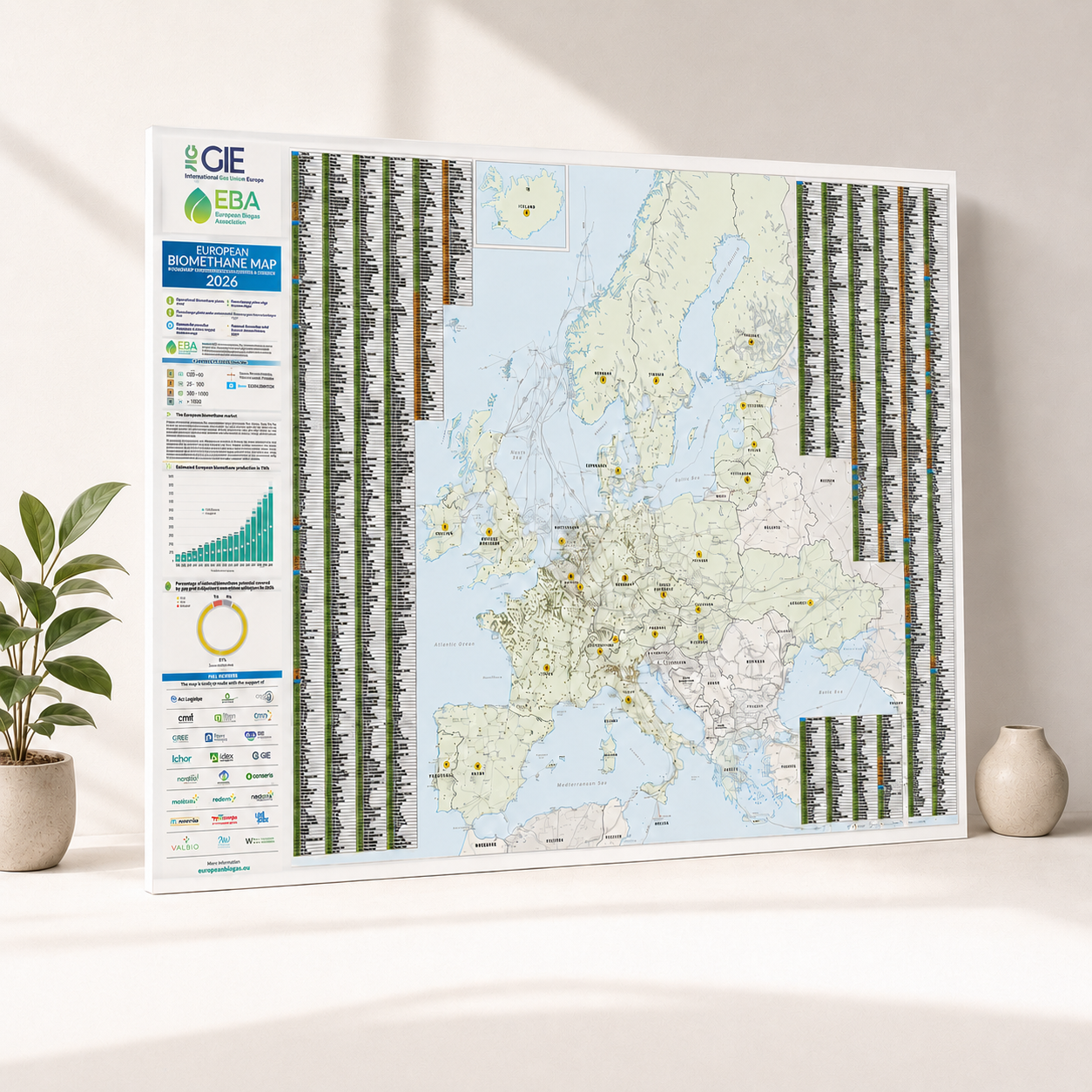
For GIE, these figures tell a broader story. Biomethane is no longer an emerging technology; it is becoming an integral part of Europe’s energy system. Around 86% of biomethane plants are already connected to the gas grid, demonstrating how existing infrastructure already enables renewable gas to reach consumers across regions and borders.
“Biomethane is becoming a strategic pillar of Europe’s energy transition. By making full use of existing gas infrastructure, we can connect production with demand across borders, strengthen Europe’s energy security and unlock the full potential of renewable gases,” said Lucie Boost, Secretary General of Gas Infrastructure Europe.
Biomethane has a vital role in strengthening Europe’s energy security and accelerating defossilisation. However, uncertainty and regulatory complexity continue to hold the sector back. We need to simplify access to sustainable feedstocks, accelerate permitting across Europe, and harmonise certification and trade, allowing the sector to scale much more rapidly,” explained Harmen Dekker, EBA’s CEO.
From local production to a European market
The latest market figures demonstrate that biomethane is steadily scaling across Europe. Produced from sustainable European feedstocks, using European technologies and value chains, biomethane strengthens Europe’s energy security while contributing to the decarbonisation of the energy system.
However, growth remains uneven. While several Member States have developed mature biomethane markets, many other are only beginning to unlock their potential. Accelerating deployment across Europe will require more than additional production capacity. It will require an integrated market capable of transporting renewable gas efficiently from where it is produced to where it is needed.
This is where gas infrastructure plays a central role. Biomethane production is often concentrated in rural areas, while demand is typically located in cities and industrial clusters. Transmission networks, storage facilities and cross-border interconnections ensure that renewable gas can circulate efficiently across Europe rather than remaining constrained to local consumption.
Creating the conditions for the next phase of growth
The strong market momentum reflected in this year’s Biomethane Map should now be matched by an enabling framework that supports the next phase of biomethane deployment.
To accelerate the development of a truly European biomethane market, GIE highlights four priorities:
- Stable and predictable investment frameworks supporting the full biomethane value chain, from production and grid connection to system integration.
- Efficient infrastructure planning and investment, recognising that grid reinforcements and system upgrades provide benefits across the entire energy system.
- Interoperable certification schemes and Guarantees of Origin, enabling renewable gases to move freely across borders and strengthening market liquidity.
- Greater transparency on grid access conditions, injection requirements and available capacity under the EU Biomethane Mechanism, providing investors and project developers with the information needed to bring new projects forward.
The European Biomethane Map demonstrates that Europe is steadily building a renewable gas market. The next challenge is no longer whether biomethane can be produced at scale, but how Europe enables it to circulate efficiently across an integrated energy system. With the right infrastructure, market design and regulatory framework in place, biomethane can play an even greater role in strengthening Europe’s energy security, competitiveness and climate ambitions.
Press contact
Carlos Buatas | Communications Manager | carlos.buatas@gie.eu