[custom-twitter-feeds feed=6]

ACE Terminal

SUMMARY

Import hub for (green) ammonia and hydrogen. Offering services to receive, store and transfer ammonia for the Northwest European market, including the service of cracking ammonia back to hydrogen to be fed into the Northwest European hydrogen backbone.

PROJECT


Status: FID

LOCATION

Country: Netherlands

Port Authority: Port of Rotterdam

COMPANIES

No GLE MEMBER assigned.
Other Members: Gasunie, VOPAK

OTHER

No tags assigned to this observatory post.

Downloads
no downloads

KEY FIGURES

  • ACE Terminal will start with facilities for the reception, storage and transfer of ammonia for the Northwest European market.
  • The terminal will be expanded in phases to include ammonia cracking, enabling imported ammonia to be converted back into hydrogen and fed into the Northwest European hydrogen backbone.
  • A Final Investment Decision (FID) is planned for 2029, with the first phase expected to become operational in 2032.
  • The project targets a hydrogen import capacity of 0.5 Mtpa by 2040.
  • ACE Terminal aims to reach its target capacity of 1 Mtpa of hydrogen imports by the late 2040s.
ACE Terminal

Project description

ACE Terminal is a planned import hub for green ammonia and hydrogen in the Port of Rotterdam. The terminal will offer services for receiving, storing and transferring ammonia for the Northwest European market.

Through a phased development, the project will also provide ammonia-cracking facilities. These facilities will convert imported ammonia back into hydrogen, allowing it to be fed into the Northwest European hydrogen backbone.

ACE Terminal is being developed by long-term partners Gasunie and Vopak as part of their joint ambition to support and enable the energy transition.

“ACE Terminal is developed by long-term partners Gasunie and Vopak as part of their joint ambition to support and enable the energy transition. The Port of Rotterdam has a long history of being the main energy port for Northwest Europe and is therefore best positioned to proceed in hosting the energy flows of the future.”
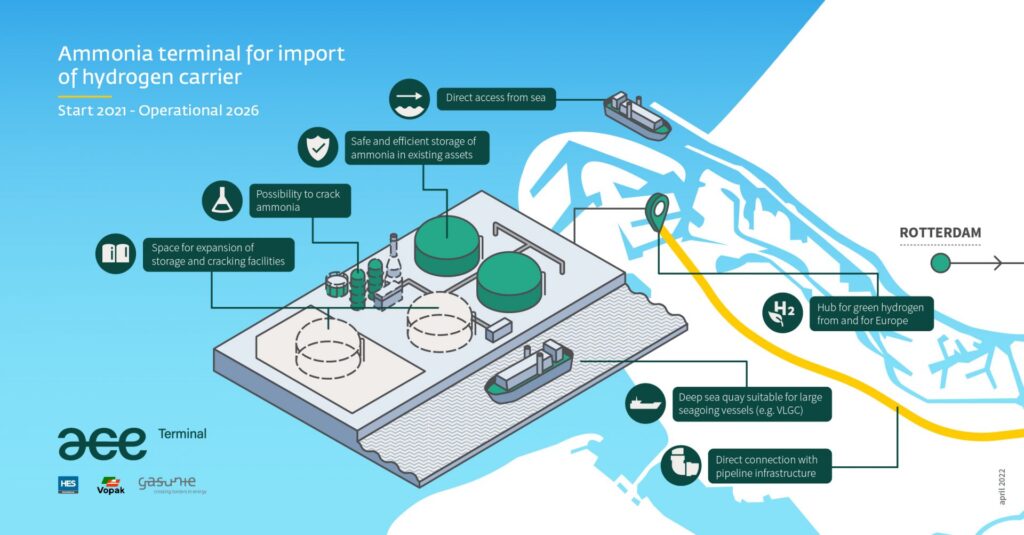
ACE Terminal is developed by long term partners Gasunie and VOPAK as part of their joint ambition to support and enable the energy transition. The Port of Rotterdam has a long history of being the main energy port for Northwest Europe and is therefore best positioned to proceed in hosting the energy flows of the future.

TIMELINE

2029

Final Investment Decision
The Final Investment Decision for the first phase of ACE Terminal is planned for 2029.

2032

First ammonia
The first phase of the terminal is expected to become operational, enabling the reception, storage and transfer of ammonia.

2033

First hydrogen
The first hydrogen is expected to become available through the cracking of imported ammonia.

2040

0.5 Mtpa hydrogen capacity
ACE Terminal aims to reach an annual hydrogen import capacity of 0.5 million tonnes.

Late 2040s

Target capacity
The terminal is expected to reach its target hydrogen import capacity of 1 million tonnes per year.